

A practical budget guide for international students comparing tuition, living costs, housing, insurance, first-month expenses, and scholarships in Turkey.
Turkey is one of the most searched study destinations for international students because it combines a large university system, English and Turkish program options, and a cost structure that can still be manageable for many families. The important word is "can." The cost of studying in Turkey is not one fixed number. It changes by university type, city, degree, language of instruction, scholarship discount, accommodation, and the way the student spends money after arrival.
This guide gives students and parents a practical way to build a Turkey study budget before applying. Use it to compare public and private universities, understand why medical programs are more expensive, estimate living costs, and prepare for first-month expenses that are easy to forget.
Quick Budget Summary
A realistic Turkey study budget has two main parts: tuition and living costs. Tuition is usually the largest academic expense, while housing is usually the largest monthly expense. Students should also add health insurance, residence permit steps, document translation, local transport, books or equipment, and arrival costs.
Public universities are often the lowest-cost route, especially outside Istanbul, but admission can be more competitive and program availability may be limited. Private foundation universities usually have higher listed tuition, yet they may offer more English-taught programs, more flexible international admission routes, and merit or early-application discounts.
For 2026-2027 planning, official university pages show wide differences. Some private universities list many non-medical programs around the mid-thousands of US dollars per year, while medicine, dentistry, and pharmacy can be much higher. For example, listed fees at several Istanbul universities show medicine in English around 24,000-36,000 USD per year, dentistry around 16,000-24,500 USD at some institutions, and many engineering, psychology, business, or communication programs at lower levels. Public university fees can be listed in Turkish lira and may be much lower, but students must confirm the current figure after official updates.
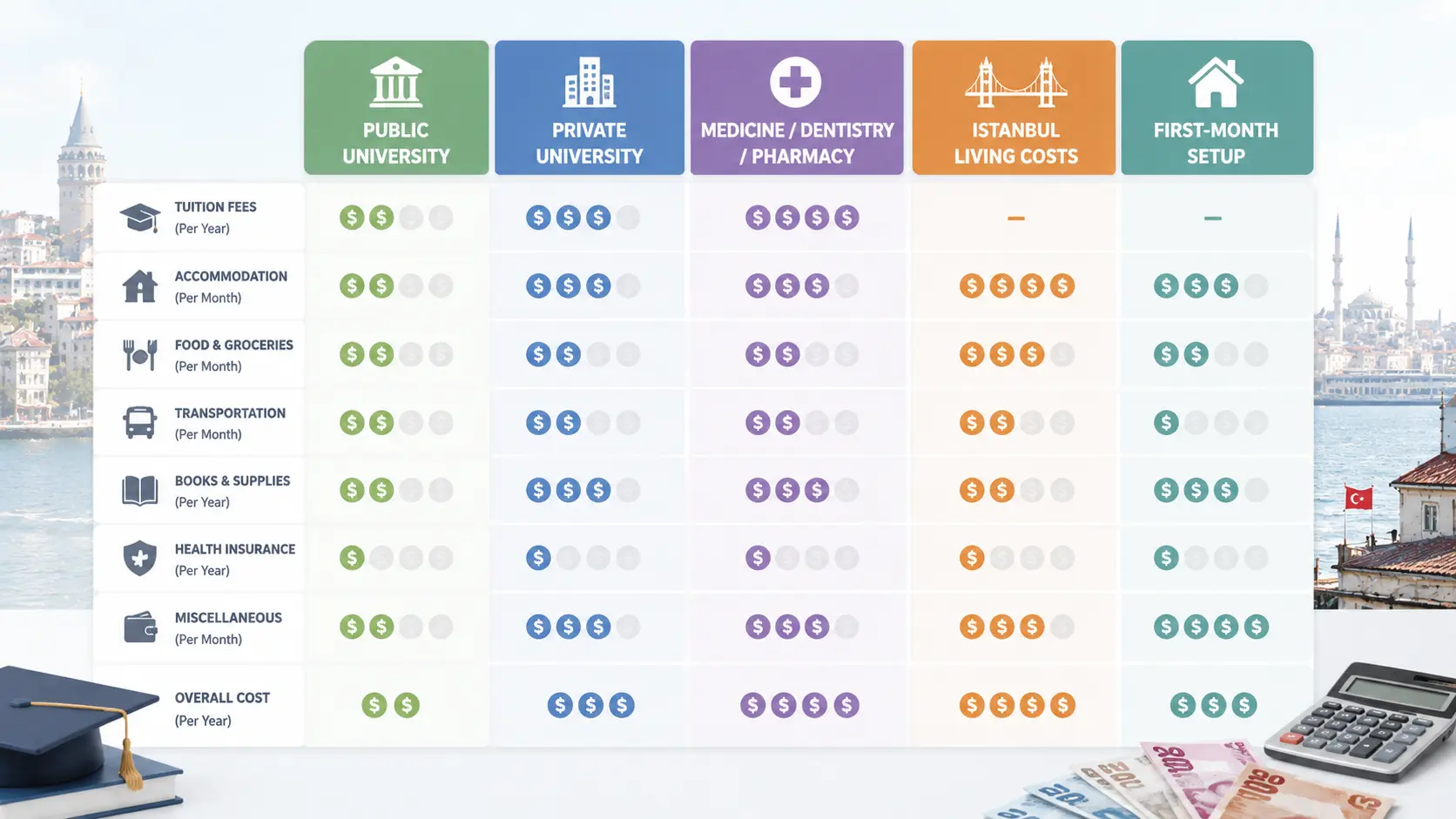
Public vs Private Tuition
Public universities are attractive because tuition can be low, especially for Turkish-taught programs and programs outside the most competitive fields. The tradeoff is admission. Public universities may ask for stronger academic results, entrance exams, international exam scores, or very competitive placement conditions. A lower tuition number does not help if the student cannot enter the program or misses the deadline.
Private foundation universities usually publish clear international tuition tables in USD or another foreign currency. They often offer direct international application review, English-taught options, and scholarship discounts. The listed fee is not always the final fee, because a student may receive a tuition discount based on grades, nationality, program, early application timing, or university policy.
When comparing two universities, do not compare sticker prices only. Compare the final payable tuition, payment schedule, scholarship renewal rules, language preparation year, registration fee, campus location, commute, and whether clinical or lab costs are included.
Medicine, Dentistry, and Pharmacy Costs
Medical and health programs usually need the highest budget in Turkey. Medicine is six years, dentistry and pharmacy are usually five years, and clinical training requires expensive university infrastructure. English-medium medical programs often cost more than Turkish-medium programs.
Students should check whether the fee covers only annual tuition or also includes VAT, student services, lab access, clinical equipment, and insurance. Some universities list a separate preparatory language fee. Others offer advance-payment discounts. For health sciences, recognition in the student's home country is also part of the real cost decision, because a cheaper program is not useful if the student cannot complete licensing steps later.
Istanbul Living Costs
Istanbul gives students the widest choice of universities, internships, clinics, transport links, and international communities. It is also usually more expensive than smaller cities. Housing is the biggest difference. A student in a shared apartment far from campus, a university dormitory, and a private studio in a central district will have very different monthly budgets.
A practical monthly budget should include rent or dormitory fee, food, local transport, mobile phone, internet, basic personal expenses, books or software, health-related costs, and a small emergency reserve. Students who cook at home, use public transport, and live near campus can control costs better than students who rely on taxis, frequent delivery food, or central private housing.
Hidden First-Month Costs
Many families plan annual tuition and monthly rent, then get surprised by arrival costs. The first month can include a housing deposit, first rent payment, bedding, kitchen basics, local SIM card, transport card, residence permit photos, document translation, notarization, health insurance, airport transfer, and extra food or transport while the student is settling in.
Build a separate first-month budget before travel. Keep digital and printed copies of the passport, acceptance letter, payment receipts, photos, insurance, address details, and academic documents. A little organization before arrival can prevent expensive last-minute fixes.

Example Student Budgets
A low-cost plan usually means a public or discounted private program, shared housing or dormitory, Turkish-taught or lower-fee program, and careful daily spending. A mid-range plan may include a private university with a scholarship discount, English instruction, shared apartment or quality dormitory, and a normal student lifestyle. A higher budget plan usually includes medicine, dentistry, pharmacy, a central Istanbul location, private accommodation, or frequent travel.
Parents should ask three questions before approving a budget: What is the confirmed tuition after discount? What is the housing plan for the first semester? What extra amount is available if the exchange rate, rent, or residence process changes?
Saving With Scholarships
Students often use the word scholarship for two different things. The first is a government-funded scholarship such as Türkiye Scholarships. The second is a university tuition discount. They are not the same.
Türkiye Scholarships receives applications through its official system and commonly uses a January-February application window. The program can support selected students, but it is competitive and not guaranteed. University discounts are more common in private university recruitment and may reduce tuition only, not living expenses.
Never build a plan around an unconfirmed scholarship. Apply early, keep backup options, and ask whether the discount is renewed every year or depends on academic performance.
What to Ask Before You Pay
Before a family pays a deposit or confirms a university, the student should ask for the total payable amount in writing. The answer should separate annual tuition, any scholarship discount, registration fees, language preparation fees, payment deadlines, and refund rules. This is especially important when comparing private universities, because two offers can look similar at first but have different renewal rules, installment options, or extra costs.
Ask whether the quoted amount is fixed for the whole program or only for the first year. Some universities publish annual fees for newly registered students, while continuing-student fees may be handled through the student system or updated later. If the student receives a scholarship discount, ask whether it applies automatically every year, whether the student must keep a minimum GPA, and whether failing a year affects the discount.
Families should also ask which currency is used for payment. Some universities list fees in USD or EUR, while public university fees may be listed in Turkish lira. Currency movement can change the real family budget, so it is safer to keep a small reserve instead of using every available dollar for the first payment.
Housing Choices and Budget Control
Housing can make or break a student budget in Turkey. University dormitories may be simpler to arrange and easier for first-year students, but availability, rules, meal plans, and distance from campus can vary. Private dormitories may offer more services, yet they can be more expensive. Shared apartments can reduce monthly cost, but students need to think about deposits, furniture, bills, commute, and whether the lease terms are clear.
For a first-year student, the cheapest option is not always the best option. A very cheap apartment far from campus can create higher transport costs, fatigue, safety concerns, and missed classes. A slightly higher rent near campus may save time and reduce stress. Parents should compare the full monthly picture: rent, bills, transport, food access, neighborhood, and how quickly the student can reach classes or clinics.
If the student is arriving in Istanbul, it can be wise to arrange temporary accommodation first, then inspect long-term options after arrival with support from someone who understands the city. Signing a long lease before seeing the room, commute, and building conditions can create expensive problems.
Language Preparation and Extra Academic Costs
Students often focus on the main degree tuition and forget language preparation. If the program is in English, the university may ask for an English proficiency exam, an internal language test, or an English preparatory year. If the program is in Turkish, the student may need TÖMER or another Turkish language pathway. These costs can add a full year of tuition or separate course fees before the student starts the main degree.
Academic materials should also be considered. Engineering and design students may need software, a stronger laptop, studio materials, or printing. Health science students may need lab coats, equipment, clinical materials, vaccinations, or extra documents for hospital training. Architecture students may spend more on models, portfolio work, and design tools. These are not always large compared with tuition, but they matter when the family budget is tight.
Ask the university or advisor whether the program has known extra costs. A realistic budget should include not only the advertised tuition but also the tools the student needs to succeed in that program.
Building a Parent-Friendly Budget Sheet
A simple budget sheet can prevent confusion between students and parents. Start with one-time costs, then annual costs, then monthly costs. One-time costs may include application support, document translation, notarization, flight, housing deposit, and arrival setup. Annual costs include tuition, health insurance, residence renewal, and books. Monthly costs include housing, food, transport, phone, internet, personal spending, and emergency savings.
It is also helpful to create three scenarios. The conservative scenario assumes higher rent, no scholarship, and extra first-month costs. The expected scenario uses the confirmed university offer and a normal housing plan. The savings scenario assumes a stronger scholarship, lower-cost city, or shared accommodation. When families see all three scenarios, they can choose with less pressure and fewer surprises.
Students should update this budget after receiving the official offer letter. A budget made before admission is useful for planning, but the final decision should use confirmed numbers from the university and realistic housing information.
Common Budget Mistakes
The first mistake is comparing countries using only tuition. A low tuition country can still become expensive if housing, transport, visa steps, or flights are high. The second mistake is choosing a university only because the first-year discount looks attractive. Students need to understand whether the discount continues and whether the program is the right academic fit.
The third mistake is ignoring city differences. Istanbul offers opportunity, but it also demands more budget discipline. Smaller cities may offer a calmer lifestyle and lower rent, but students should check program quality, language options, and international support. The fourth mistake is leaving no emergency reserve. Even careful students can face exchange-rate changes, health costs, document corrections, or a delayed payment from home.
A strong Turkey study budget is not about fear. It is about clarity. When the student and family know the likely costs, they can focus on choosing the right program and preparing for a smoother first year.
How FKRA Helps
FKRA helps students compare Turkey programs by tuition, city, language, admission difficulty, scholarships, and application deadlines. Instead of choosing only by the cheapest fee, students can compare the full study budget and select a program that fits their academic goals and family finances.
Ready to compare affordable Turkey programs? Browse programs with FKRA and ask an advisor to help you shortlist options before deadlines get close.
Frequently Asked Questions
Is Turkey affordable for students?
Yes, Turkey can be affordable compared with many Western destinations, but the real budget depends on the university type, program, city, housing choice, and scholarship discount.
How much is rent in Istanbul?
Rent changes by district and housing type. Students should compare dormitories, shared apartments, and private studios, then add deposits and utilities to the first-month budget.
Are English programs more expensive?
Sometimes. English-taught programs, especially medicine, dentistry, pharmacy, engineering, and private university programs, can cost more than Turkish-taught alternatives.
What costs should parents expect?
Parents should plan for tuition, housing, food, transport, health insurance, documents, residence steps, flight, deposit, and emergency money for the first month.
Ready to plan your application?
FKRA can help you compare programs, prepare documents, and apply with a clear next step.